

High-Reliability Solder Joint Reinforcement for Anti-Surge Wire Wound Resistor
This technical white paper is provided by FIRSTOHM to assist customers, engineers, procurement teams, and supply chain reviewers in understanding the design concept, technical framework, key problems addressed, and the value of this patented technology in high-reliability resistor and power protection applications.
Purpose of Document
This technical white paper is provided by FIRSTOHM to assist customers, engineers, procurement teams, and supply chain reviewers in understanding the design concept, technical framework, key problems addressed, and value of this patented technology in high-reliability resistor and power protection applications.
Core Patent Information
| Patent Title | Anti-Surge Wire Wound Resistor |
|---|---|
| Patent Type | Taiwan Utility Patent |
| Certificate No. | M530462 |
| Filing Date | 2014/12/08 |
| Grant Date | 2016/10/11 |
| Assignee | FIRST RESISTOR & CONDENSER CO., LTD. |
| Inventor | LEE, SHANG YO |
| Technical Field | Reliability enhancement of wirewound resistor solder joints |
Note: Patent information is based on available records. Please refer to the official patent database for the latest legal status.
Technical Background and Problem Analysis
Wirewound resistors are widely used in industrial and power-related applications due to their high power-handling capability and stable electrical characteristics. However, in conventional manufacturing processes, the solder joint between the winding and the end cap remains a reliability risk.
This patented technology focuses on reinforcing solder joint reliability in wirewound resistors, specifically addressing potential failures under high surge currents or transient energy impacts.
- Cold solder joints or poor bonding during assembly
- Gradual degradation under high temperature or long-term load
- Mechanical stress concentration from surge currents or transient energy impacts
- Solder joint becoming the primary failure point of the resistor
Technical Solution
The core of this patented technology lies in forming an alloy electroplated reinforcement layer on the solder joint surface after the wirewound resistor is soldered.
- Enhanced mechanical strength of solder joints
- Improved bonding reliability
- Stress dispersion under surge current impacts
- Reduced risk of solder joint embrittlement and fracture
- Improved component stability under extreme conditions
This design can be regarded as a structural reinforcement solution targeting the critical failure point of wirewound resistors.
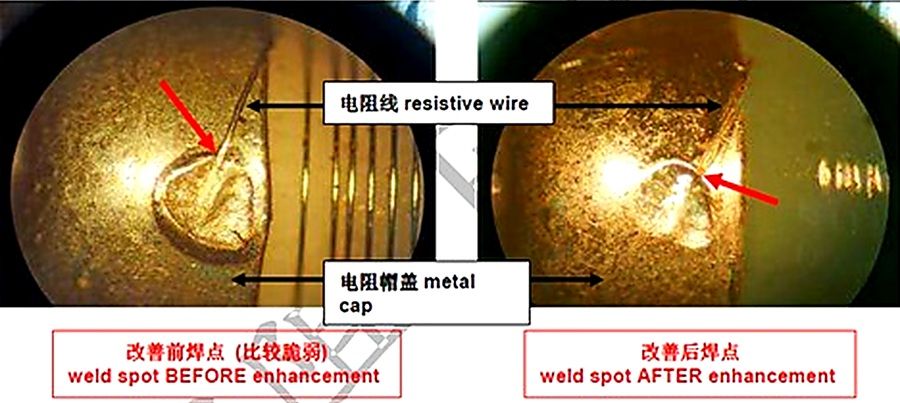
Technical Architecture
| Module | Function |
|---|---|
| Wirewound Resistor Body | Provides resistance value and power-handling capability |
| Solder Joint Structure | Key conductive interface connecting winding and end cap |
| Alloy Electroplated Reinforcement Layer | Enhances mechanical strength and bonding reliability |
| Surge-Resistant Structural Design | Improves stability under transient high-energy impacts |
Application Fields and Market Relevance
- Industrial power supplies
- Battery charging and protection systems
- Advanced LED lighting drivers
- Electric vehicle applications
- Motor drive and protection systems
- Energy storage and photovoltaic inverter systems
Customer Value
This technology directly addresses customers' critical requirements in high reliability applications.
| Customer Need | Technical Value |
|---|---|
| Improved joint reliability | Reinforced solder joint integrity |
| Enhanced surge tolerance | Reduced failure from transient energy |
| Increased product stability | Strengthened long-term operational consistency |
| Support for power protection design | Improved system safety margin |
| Reduced maintenance and failure risk | Lower critical joint failure rate |
Technical Abstract
Patent M530462 represents a key technology for enhancing solder joint reliability in wirewound resistors. By introducing an alloy electroplated reinforcement layer on the solder joint surface, it effectively mitigates solder joint brittleness and fracture risks under surge current or transient energy conditions, thereby improving the overall reliability and service life of power protection components.
Key Technical Highlights
- Reinforced solder joint reliability design
- Alloy electroplated structural reinforcement
- Surge stress dispersion mechanism
- Wirewound resistor failure point improvement
- High-reliability power application-oriented design
- Specification
-

Anti-Surge Wirewound MELF Resistor
Anti-Surge Wirewound MELF Resistor can operate in high ambient temperature with less resistance drift.
Download
